
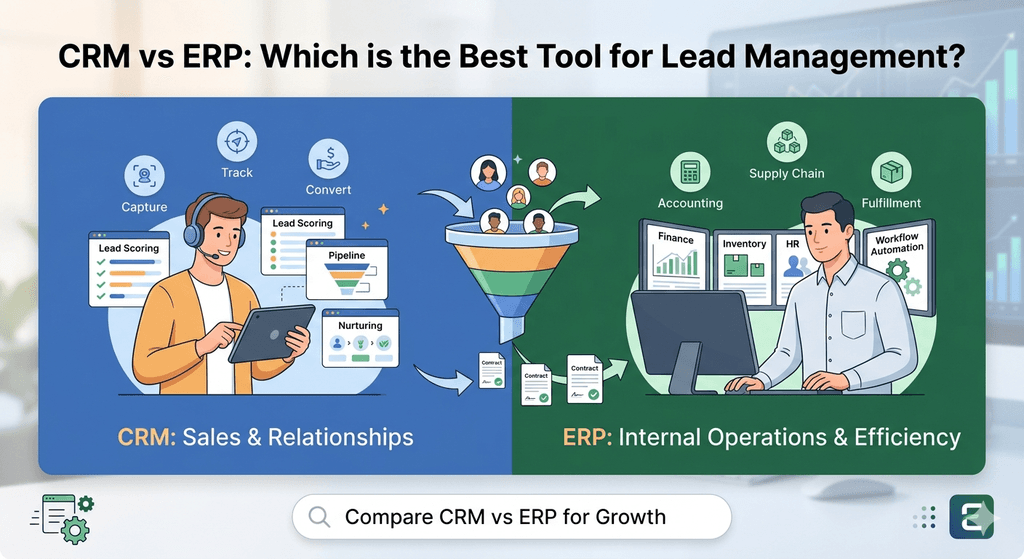
What is Lead Management?
Lead management is the systematic process of capturing, tracking, and nurturing potential customers. Without a robust automation system, leads often fall through the cracks due to delayed follow-ups or lack of data. Effective management requires full visibility into the sales funnel okfrom the first point of contact to the final handshake.
CRM: The Front-End Growth Engine
A Customer Relationship Management (CRM) system is purpose-built for sales and marketing. Its primary goal is to increase revenue by managing every interaction with potential and existing clients.
- Automated Lead Capture: Seamlessly pull leads from website forms, social media ads, and email campaigns into a single dashboard.
- Lead Scoring & Prioritization: Use data to identify "hot" leads that are most likely to convert, allowing your sales team to focus their energy where it matters.
- Sales Pipeline Visualization: Track the journey of every prospect through various stages of the sales cycle.
- Engagement Automation: Schedule automated follow-ups and personalized emails to ensure your brand stays top-of-mind.
Best For: Teams focused on customer acquisition, relationship building, and sales performance.
ERP: The Backend Operational Backbone
Enterprise Resource Planning (ERP) software focuses on the internal mechanics of a business. It integrates core processes like finance, inventory, human resources, and supply chain management into one unified system.
While some ERPs offer basic sales modules, their true power lies in what happens after a lead is converted:
- Order & Contract Management: Transitioning a closed deal into a live project or order.
- Resource Allocation: Ensuring the inventory or manpower is available to fulfill the client’s needs.
- Financial Integration: Linking sales data directly to billing, accounting, and payroll.
Best For: Organizations looking to streamline internal workflows, manage complex supply chains, and ensure financial accuracy.
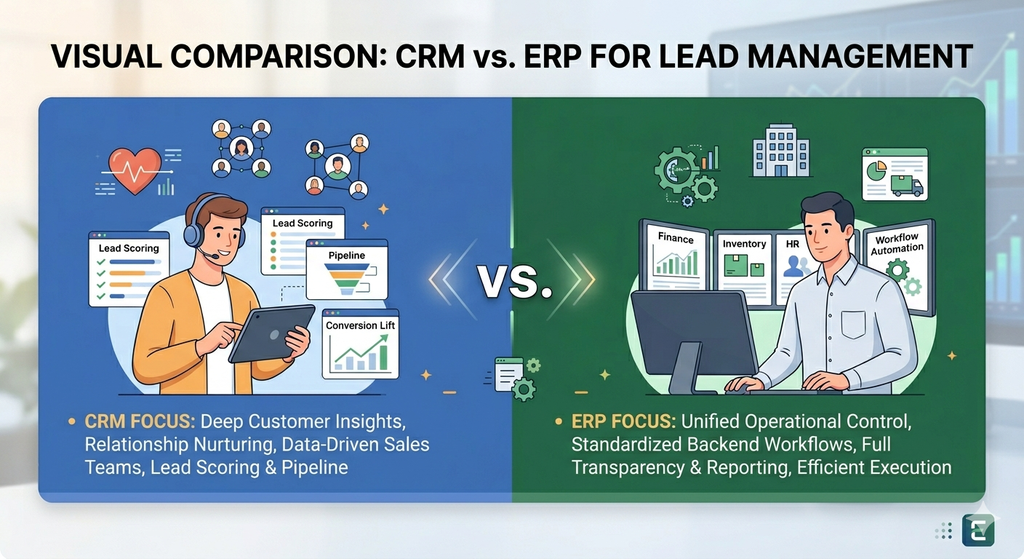
Quick Comparison: CRM vs. ERP
| Feature | CRM | ERP |
| Primary Focus | Sales, Marketing, and Support | Finance, Operations, and HR |
| Objective | Increasing Revenue (Front-end) | Increasing Efficiency (Back-end) |
| Lead Tracking | Highly Advanced & Specialized | Basic or Limited |
| Key Benefit | Improved Conversion Rates | Streamlined Business Processes |
The Verdict: Which One Do You Need?
If your immediate priority is lead nurturing and sales growth, a dedicated CRM is the clear winner. It provides the specialized tools your sales team needs to be proactive rather than reactive.
However, for a truly automated business, the "Gold Standard" is Integration. When your CRM talks to your ERP, you create a frictionless flow of data. Once a lead is won in the CRM, the ERP automatically handles the invoicing and fulfillment. This end-to-end automation eliminates manual data entry and provides a 360-degree view of your business health.
Conclusion
Choosing the right tool depends on your current business stage. Modern automation providers, like Ecowin, specialize in bridging these gaps ensuring that your lead management is not just a list of names, but a high-performance engine driving your company’s 2026 growth goals.